If you are considering buying property in Cyprus in 2026, one question probably comes first:
“Is Cyprus property still a good investment?”
The answer can be yes—but investors should avoid looking at Cyprus as one single property market.
Different cities, neighborhoods and property types can perform very differently. A property that represents an excellent investment in one location may not offer the same potential in another.
For this reason, the right question is not simply whether Cyprus property is a good investment. It is:
“Which property, in which location, at which price, makes sense for my investment objectives?”
The Cyprus Property Market in 2026
The Cyprus property market has remained active in 2026, with apartments continuing to demonstrate resilience.
Recent RICS (Royal Institution of Chartered Surveyors) Cyprus Property Price Index data show that property performance varies between districts and property types. This is particularly important for investors because headline market growth does not mean that every property will appreciate at the same rate.
The strongest investment opportunities are usually found by combining several factors:
- Location
- Purchase price
- Rental demand
- Property quality
- Future supply
- Infrastructure
- Financing
- Operating costs
- Potential capital appreciation
- Exit strategy
In other words, property selection matters more than simply choosing a country.
Rental Income: One of the Main Attractions
Rental income is one of the primary reasons investors choose residential property in Cyprus.
The basic calculation is:
Gross Rental Yield = Annual Rental Income ÷ Purchase Price × 100
For example, if you purchase a property for €250,000 and rent it for €1,200 per month:
- Annual rental income: €14,400
- Purchase price: €250,000
- Gross rental yield: 5.76%
However, gross rental yield should never be the only number an investor considers.
The actual return can be affected by:
- Property management
- Maintenance
- Insurance
- Common expenses
- Vacancy periods
- Taxes
- Repairs
- Financing costs
- Furnishing and replacement costs
This means that an attractive gross yield does not automatically mean an attractive investment.
The more important question is:
“What will my net return be after all relevant expenses?”
Capital Appreciation
Rental income is only one component of a property investment.
The second is potential capital appreciation.
An investor may purchase a property today with the expectation that its value will increase over the long term.
However, appreciation should never be guaranteed or assumed.
Investors should instead examine the fundamentals that may support future demand, including:
- Population growth
- Employment
- Infrastructure
- Tourism
- Foreign investment
- New development
- Limited supply in desirable locations
- Quality of the surrounding neighbourhood
- Accessibility
The stronger these fundamentals are, the more interesting the location may become.
Larnaca vs. Limassol vs. Paphos
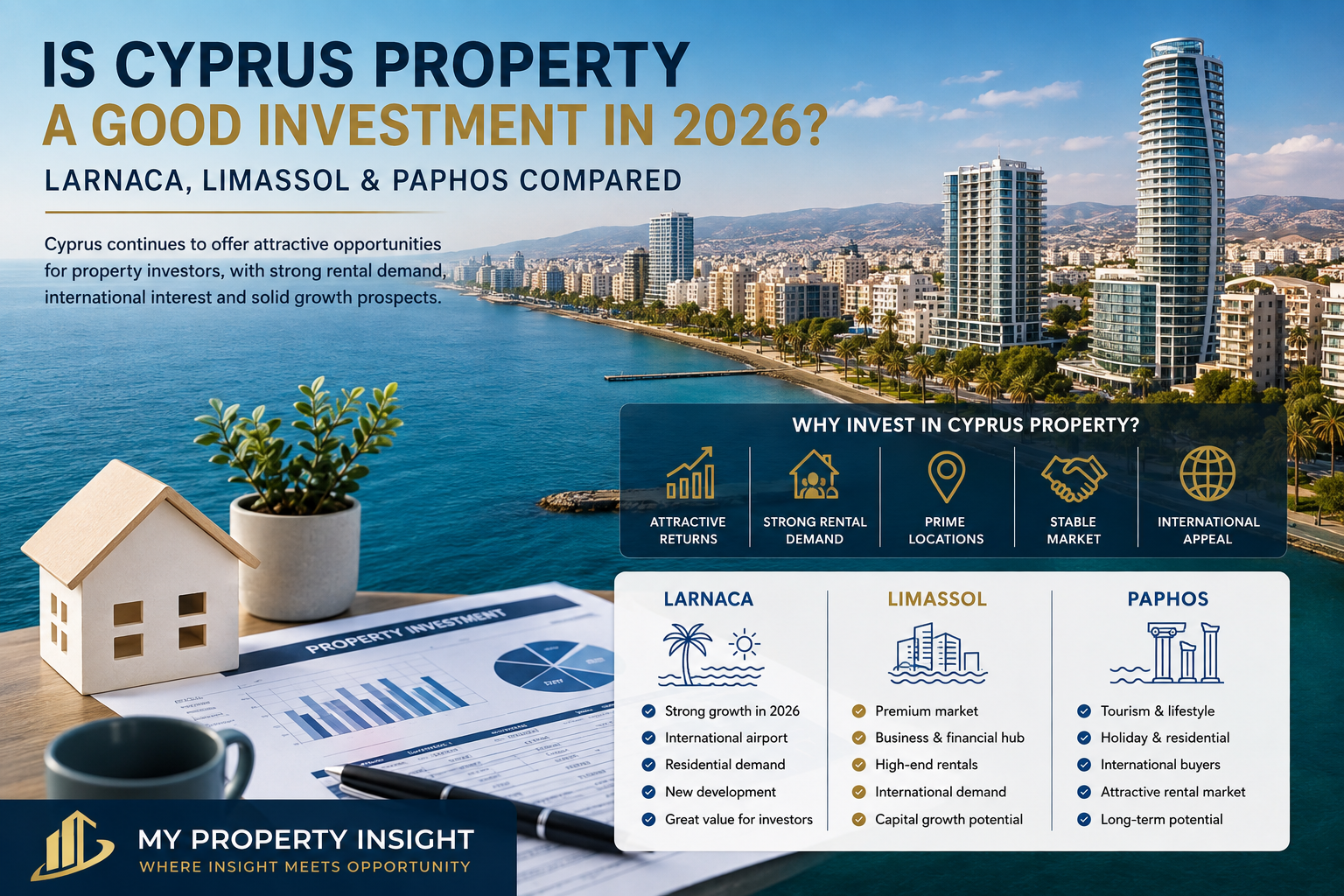
When discussing property investment in Cyprus, three locations frequently attract international buyers:
Larnaca, Limassol and Paphos.
All three offer opportunities, but they represent different investment propositions.
Larnaca: A Market to Watch Closely
Larnaca has become increasingly interesting for property investors in recent years.
The city combines:
- An international airport
- Coastal lifestyle
- Established infrastructure
- Tourism
- Residential demand
- New development
- Growing international interest
Its accessibility is a major advantage for overseas owners and investors.
The latest RICS Cyprus Property Price Index for Q2 2026 is particularly interesting. Larnaca recorded the strongest quarterly growth among Cyprus districts across several major property categories. Apartment values increased by 5.59% quarter-on-quarter, while houses increased by 4.48%. Office and warehouse values also recorded strong quarterly increases.
This does not mean that every property in Larnaca is automatically a good investment.
The exact location, purchase price, construction quality, rental demand and future competing supply remain crucial.
Nevertheless, the combination of recent market momentum, international accessibility and residential demand makes Larnaca a market investors should examine carefully in 2026.
Limassol: Premium and International
Limassol offers a different investment proposition.
It is one of Cyprus’s most internationally oriented cities, with a strong business community, international residents, premium developments and a well-established luxury property market.
Limassol can be particularly attractive for investors targeting:
- High-end residential property
- International professionals
- Executive rentals
- Luxury developments
- Business-related demand
- Premium coastal locations
The main consideration is the higher entry price.
A premium property can be an excellent investment, but the investor needs to establish whether the expected rental income and long-term value justify the initial acquisition cost.
For this reason, comparing yield and total investment cost is particularly important in Limassol.
Paphos: Lifestyle and Tourism
Paphos has a different profile again.
Its international reputation, tourism sector and Mediterranean lifestyle make it particularly attractive to:
- Holiday-home buyers
- Retirees
- Second-home owners
- International investors
- Buyers seeking tourism-related rental opportunities
Paphos can therefore be particularly interesting for investors whose strategy is linked to tourism and lifestyle demand.
However, investors should carefully distinguish between a property that depends heavily on seasonal tourism and one that can also attract stable long-term tenants.
Which City Is Best for Investment?
There is no universal answer.
Larnaca may suit investors looking for:
A combination of accessibility, residential demand, development and potential growth.
The latest 2026 market data make Larnaca particularly interesting because of its strong quarterly performance across several property categories.
Limassol may suit investors looking for:
A premium international market with strong business and executive demand.
The higher acquisition cost means that the investment numbers should be analysed carefully.
Paphos may suit investors looking for:
Lifestyle, tourism and holiday-property exposure.
This can be particularly relevant for buyers who want to combine personal use with an investment strategy.
New Build or Resale?
Another important investment decision is whether to purchase a new-build or resale property.
New-build properties
Advantages can include:
- Modern construction
- Energy efficiency
- Contemporary design
- Lower immediate maintenance
- Modern amenities
- Potentially attractive payment structures
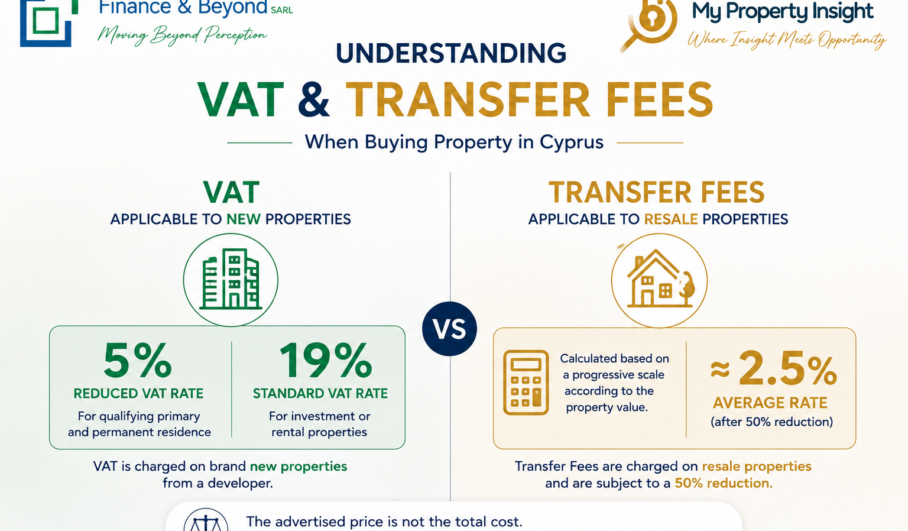
However, new properties may be subject to VAT, and off-plan purchases require careful consideration of the developer, contract, payment schedule and delivery timeline.
Resale properties
Resale properties can offer:
- Immediate availability
- Established neighbourhoods
- Existing rental history
- The ability to inspect the finished property
- Potential renovation opportunities
Neither option is automatically better.
The right choice depends on the property, the price and the investor’s strategy.
What About Off-Plan Investments?
Off-plan property can be attractive when the purchase price provides sufficient value compared with the expected completed property.
However, investors should carefully assess:
- Developer reputation
- Construction timetable
- Payment schedule
- Contractual protections
- Final specifications
- Expected rental demand
- Future competing developments
A lower initial price is not necessarily a bargain if the development carries excessive risk.
Financing Can Change the Investment Equation
Financing can potentially improve an investor’s return on equity because the buyer is using a combination of personal capital and borrowed funds.
However, financing also introduces additional risk.
The investor should consider:
Rental income – operating expenses – financing costs = actual cash flow
A property that appears attractive without financing may produce a very different result once loan repayments are included.
For this reason, investors should analyse the property using realistic assumptions rather than relying on optimistic rental or appreciation forecasts.
What Are the Risks?
No property investment is risk-free.
Potential risks include:
Property price risk
Market values can fall as well as rise.
Rental risk
The property may generate less rental income than expected.
Vacancy risk
There may be periods when the property is unoccupied.
Construction risk
Off-plan developments can experience delays or changes.
Interest-rate risk
Financing costs can affect cash flow.
Regulatory risk
Tax, rental and property regulations can change.
Oversupply
A large number of new apartments in the same area may increase competition between landlords.
Understanding these risks is an essential part of professional property investment.
The Most Important Question: Your Exit Strategy
Before buying, ask yourself:
“Who will buy this property from me in five or ten years?”
This is one of the most useful questions an investor can ask.
A property with broad appeal may be easier to rent and resell.
For example, a well-designed two-bedroom apartment in a desirable location may appeal to:
- Local families
- Professionals
- International residents
- Investors
- Future owner-occupiers
A highly specialised property may have a much smaller resale market.
Your exit strategy should therefore be considered before you buy, not after.
So, Is Cyprus Property a Good Investment in 2026?
It can be—but the answer depends on the property.
Cyprus continues to offer interesting opportunities for residential property investors, particularly in locations where demand, infrastructure and development support the market.
But investors should avoid buying simply because:
- “Prices are going up.”
- “Everyone is buying.”
- “The property is beautiful.”
- “The developer says it will appreciate.”
Instead, look at the complete investment equation:
Purchase Price + Acquisition Costs + Financing + Operating Costs + Rental Income + Potential Appreciation + Exit Strategy
That is the real investment analysis.
The MY PROPERTY INSIGHT Approach
At MY PROPERTY INSIGHT, we believe property investment should begin with the investor’s objective, not with the property listing.
Before considering a property, ask:
- What is my investment budget?
- What return am I targeting?
- Am I looking for rental income, capital growth, or both?
- How long do I intend to hold the property?
- Will I finance the purchase?
- Do I prefer new-build or resale?
- Who is my target tenant?
- What is my exit strategy?
Only after answering these questions can you properly evaluate whether a property makes sense.
Our role is not simply to show you what is available.
It is to help you understand why a particular property may—or may not—make sense for your objectives.
Final Thoughts
Cyprus can offer attractive opportunities for property investors in 2026.
Larnaca currently stands out for its combination of strong recent market momentum, accessibility and broad residential appeal.
Limassol remains compelling for investors targeting a premium, internationally driven market.
Paphos continues to offer opportunities for buyers focused on lifestyle, tourism and international demand.
But the best investment is not necessarily in the city with the highest headline growth.
It is the property that offers the right combination of:
Location + Price + Quality + Rental Demand + Potential Growth + Risk + Exit Strategy.
The most important question is therefore not:
“Is Cyprus property a good investment?”
It is:
“Is this particular property a good investment for me?”
That is the level at which a serious investment decision should be made.
MY PROPERTY INSIGHT — Where Insight Meets Opportunity.
This article is provided for general information only and does not constitute investment, financial, legal or tax advice. Property investment involves risk, and past market performance does not guarantee future results. Investors should obtain independent professional advice before making an investment decision.