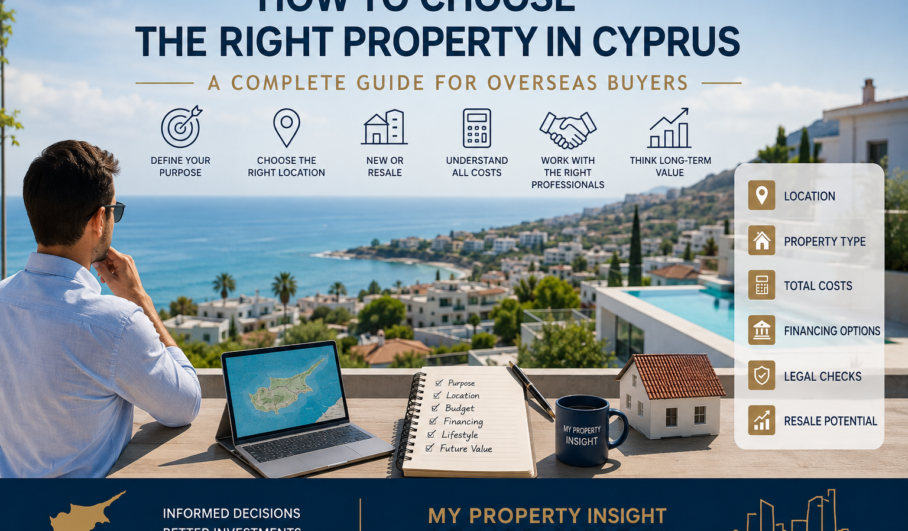
Cyprus has become an increasingly attractive destination for international property buyers. Whether you are looking for a holiday home, a permanent residence, a retirement property or an investment, Cyprus offers a combination of Mediterranean lifestyle, European infrastructure and a well-established real estate market.
But buying property in another country is different from buying locally. Understanding the process before you start looking can save you time, unnecessary costs and potential complications.
Here is a practical step-by-step guide to buying property in Cyprus as a foreign buyer in 2026.
1. Define Your Objective Before Looking at Properties
The first question is not “Which apartment should I buy?”
It is:
“Why am I buying property in Cyprus?”
Your objective will influence almost every subsequent decision.
For example, a buyer looking for a holiday home may prioritise location, sea views and proximity to restaurants and beaches.
An investor may be more interested in rental demand, property appreciation, operating costs and resale potential.
A family planning to relocate may prioritise schools, hospitals, supermarkets and access to transportation.
If residency is part of your objective, the property’s value, type and eligibility become particularly important.
Defining your objective first helps you avoid buying a property simply because it looks attractive.
2. Choose the Right Location
Cyprus is a relatively small island, but its property markets are very different.
Larnaca can be attractive to buyers looking for a coastal lifestyle combined with relatively accessible property prices and an international airport.
Limassol offers a more international business environment and strong demand, but property prices are generally higher.
Paphos is particularly popular with international buyers looking for lifestyle, retirement and holiday properties.
Nicosia is the capital and has a more locally driven residential and business market.
There is no single “best” city.
The right location depends on your budget, lifestyle and investment objective.
3. Establish Your Total Budget
Do not calculate your budget based only on the advertised property price.
You should also consider:
- VAT, where applicable
- Transfer fees
- Legal fees
- Stamp duty
- Property registration-related costs
- Bank and financing costs, if applicable
- Insurance
- Furnishing and renovation
- Ongoing maintenance
The tax treatment depends on the transaction and property. Cyprus also has specific VAT rules for qualifying primary residences, so buyers should establish their eligibility before assuming that a reduced VAT rate applies.
4. Decide Whether You Need Financing
Foreign buyers can consider financing their purchase through a Cyprus bank, subject to the bank’s eligibility criteria, income profile and documentation requirements.
If you need financing, it is better to understand your potential borrowing capacity before selecting the property.
This allows you to establish a realistic purchase budget instead of falling in love with a property that does not fit your financing capacity.
5. Find the Right Property
Once your objectives and budget are clear, you can start comparing properties.
Do not focus only on the apartment itself.
Consider:
- Location
- Developer reputation
- Construction quality
- Energy efficiency
- Building management
- Parking
- Storage
- Views
- Future surrounding development
- Rental demand
- Resale potential
- Completion date for new developments
A professional property advisor can help you compare several properties objectively instead of simply showing you individual listings.
6. Carry Out Legal Due Diligence
Before signing a purchase agreement, appropriate legal due diligence is essential.
Your lawyer should examine the property’s legal status, title information and relevant permits and documentation.
For non-EU buyers, the Cyprus Ministry of Interior confirms that permission from the relevant District Administration is required to acquire immovable property. The official process includes documentation relating to the property, the buyer and financial standing.
7. Sign the Contract of Sale
Once the property has been selected and the legal checks are satisfactory, the parties can proceed with the contract of sale.
The contract should clearly identify:
- Purchase price
- Payment schedule
- Completion or delivery terms
- Property specifications
- Included items
- Conditions of the transaction
- Any relevant guarantees or obligations
Never rush this stage simply because you are concerned that another buyer may purchase the property.
8. Complete the Purchase
The final stage involves completing the agreed payments and the relevant registration procedures.
The exact process depends on the property, the buyer’s nationality and the transaction structure.
For a VAT-applicable transaction, transfer-fee treatment is different from a transaction that is not subject to VAT. The Department of Lands and Surveys confirms that qualifying VAT transactions can be exempt from transfer fees, while transactions not subject to VAT may benefit from a 50% exemption.
9. Think Beyond the Purchase
Buying the property is only the beginning.
If you plan to rent it, you need to consider property management, tenant selection, maintenance and taxation.
If it is a holiday home, you need to consider security, maintenance and insurance.
If it is intended as your future residence, you should consider schools, healthcare, transportation and daily living.
Final Thoughts
Buying property in Cyprus can be a rewarding decision, but successful property ownership starts with good preparation.
The most important principle is simple:
Do not choose the property first and then try to make the numbers work. Establish your objective, budget and strategy first, and then choose the property that fits them.
At MY PROPERTY INSIGHT, our role is to help international buyers understand the Cyprus property market, compare opportunities and make informed decisions based on their individual objectives.